

Blog
Block by Block Brings More Responsive, Data-Driven Approach to the Port Authority ACES Program
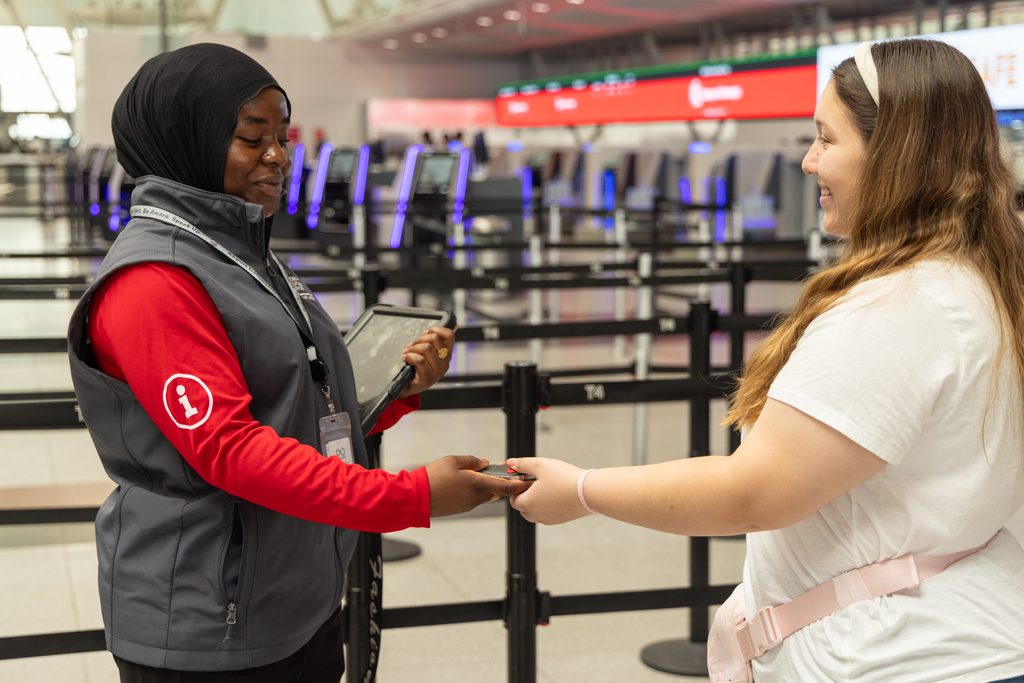
New York, NY. – For the 120 million to 130 million travelers moving through the Port Authority of New York and New Jersey airport system each year, the difference between a stressful arrival and a smoother experience often comes down to one simple thing: finding the right help at the right time.
That is the work at the heart of the ACES program, short for Airport Customer Experience Specialists. Through its new contract with the Port Authority, Block by Block now manages teams that provide hospitality, wayfinding and customer care support at four major airports: John F. Kennedy International Airport, Newark Liberty International Airport, LaGuardia Airport and New York Stewart International Airport.
ACES team members are stationed in high-visibility locations, including arrivals areas, where travelers frequently need quick answers and calm guidance. They help people understand transportation options, find taxis or rideshare locations, navigate terminals, locate hotels or meal options and get general assistance in an airport environment that can be challenging even for experienced travelers.
For Block by Block, the Port Authority contract is both a significant operational opportunity and a natural extension of the company’s broader work in public spaces.
The company built its business model around making busy, public spaces feel friendlier, safer, cleaner and easier to use. Block by Block trains Ambassadors throughout the country to begin their work with a smile, proactively greeting people to see how they can help.

The Port Authority and Block by Block are working to build on that culture to raise the level of service to travelers while also gathering better information to manage and improve the program.
“Block by Block has a long history of working with communities to make improvements to hospitality, cleanliness, safety and comfort on sidewalks, in parks and other public areas,” said Block by Block President Blair McBride. “In recent years, we’ve extended our reach into supporting major transit systems, and airports were the obvious next step.”
“This evolution is centered around people,” he added. “We focus on hiring people who love to serve the people who gather in public spaces, whether that’s to visit restaurants and shops in a business district, use a bus or train to go to work or travel through an airport for leisure or business. They all want their experience to be easy and enjoyable.”
Managing a complex transition
Block by Block began providing services to the Port Authority airports in April, with a workforce that includes more than 200 employees across Stewart International, LaGuardia, Newark Liberty and JFK. Many employees have been part of the program for years, creating a stable foundation as Block by Block introduces new systems, expectations and management practices.
Like any large transition, the early months required the company to manage change while continuing to deliver service. The work included onboarding teams, reviewing wage structure, and building operational systems while the program continued running day to day.
That is one of the reasons Block by Block is taking a measured approach. The first phase was focused on stabilizing service, listening to employees, gathering data and identifying opportunities for improvement.
A service program built around visibility and proactive Engagement
One of Block by Block’s early priorities was to reinforce the customer engagement role of ACES team members. The goal is not simply to have employees present at the airport but also to have them positioned where they are easy to see, easy to approach and ready to offer assistance before a traveler may even realize they need help.
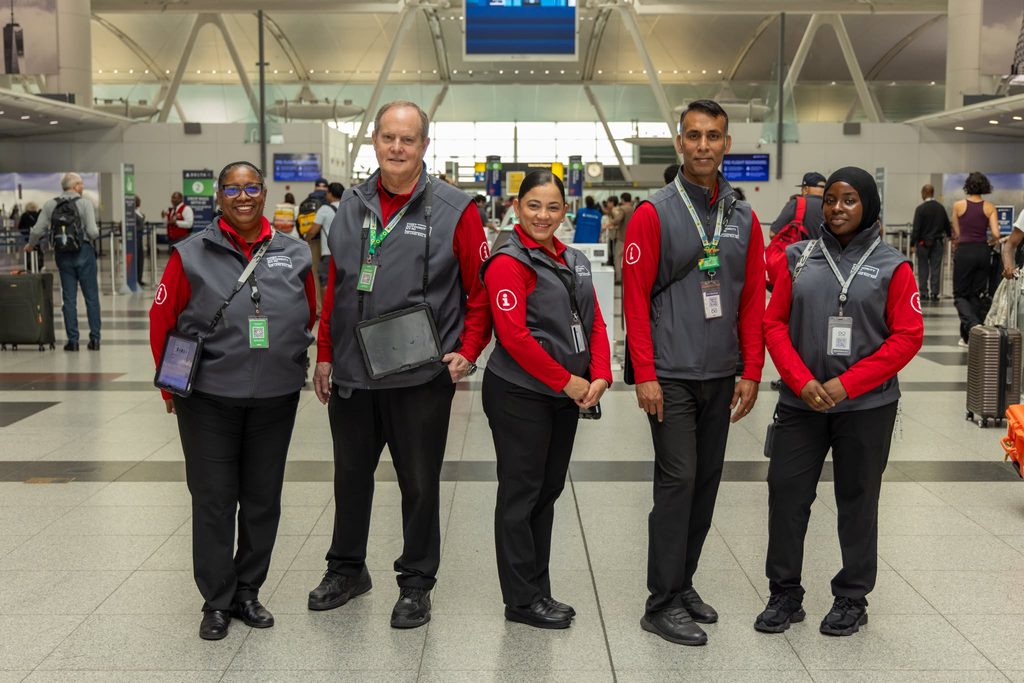
The company also invested in improving the employee experience. New uniforms are designed to be more modern, highly visible and comfortable for team members who may be standing for extended periods of time.
Employees who are easier for travelers to find and more comfortable during long shifts are better positioned to deliver consistent, friendly and effective service, according to Carin Cardone, Division Vice President for Block by Block.
“We do not want ACES team members waiting in a corner for someone to come ask a question,” Cardone said. “We want them stepping into the areas where travelers are making decisions: arrivals doors, taxi queues, rideshare pickup areas, baggage claim and other high-traffic points. Our team lets people know we are here to help. That might mean greeting a family before they start searching for ground transportation, helping an international traveler understand the next step or directing someone to the correct shuttle. Those seemingly simple, proactive encounters are sometimes the most meaningful when travelers are unsure.”
Turning activity into actionable information
Another important focus for the new program is improving data for the Port Authority. Prior to Block by Block’s contract, reporting relied heavily on paper-based statistics. Block by Block implemented its SMART System to track tasks and activity in real time, providing clearer reporting and more practical decision-making for its company leaders and the client.
More data is not always better data, Cardone noted. Block by Block continues to work with the Port Authority to refine reporting around a set of meaningful measures – 10 to 15 key statistics that help the Port Authority understand the needs of travelers and where adjustments can improve service.
Current data tracks measures such as overall traveler engagements and the nature of queries, including hotel, rental car, parking, restroom, transportation, airline and other questions as well as passenger assistance.
Block by Block logged more than 1.1 million interactions in the first 90 days of operation.
Because the ACES program operates across multiple airports with different passenger flows, staffing needs and physical layouts, efficiency is a priority. Block by Block has reviewed schedules, staffing levels, deployment patterns and management coverage to identify ways to improve performance while staying within budget.
That work includes reviewing staffing and scheduling against actual data, evaluating how team members move between terminals and considering where additional management oversight may be needed, especially on overnight shifts. Early pilot efforts at LaGuardia and Newark are helping the team test ideas and determine what can be scaled across the broader program.
“The numbers are important because they show the scale of the work, but the real measure is whether travelers feel supported in the moments that matter,” Cardone said. “Every time an ACES team member steps forward to answer a question, prevent confusion or guide someone to the right place, we are improving that customer’s experience and giving the Port Authority better insight into what travelers need. That is where this program can keep getting stronger.”